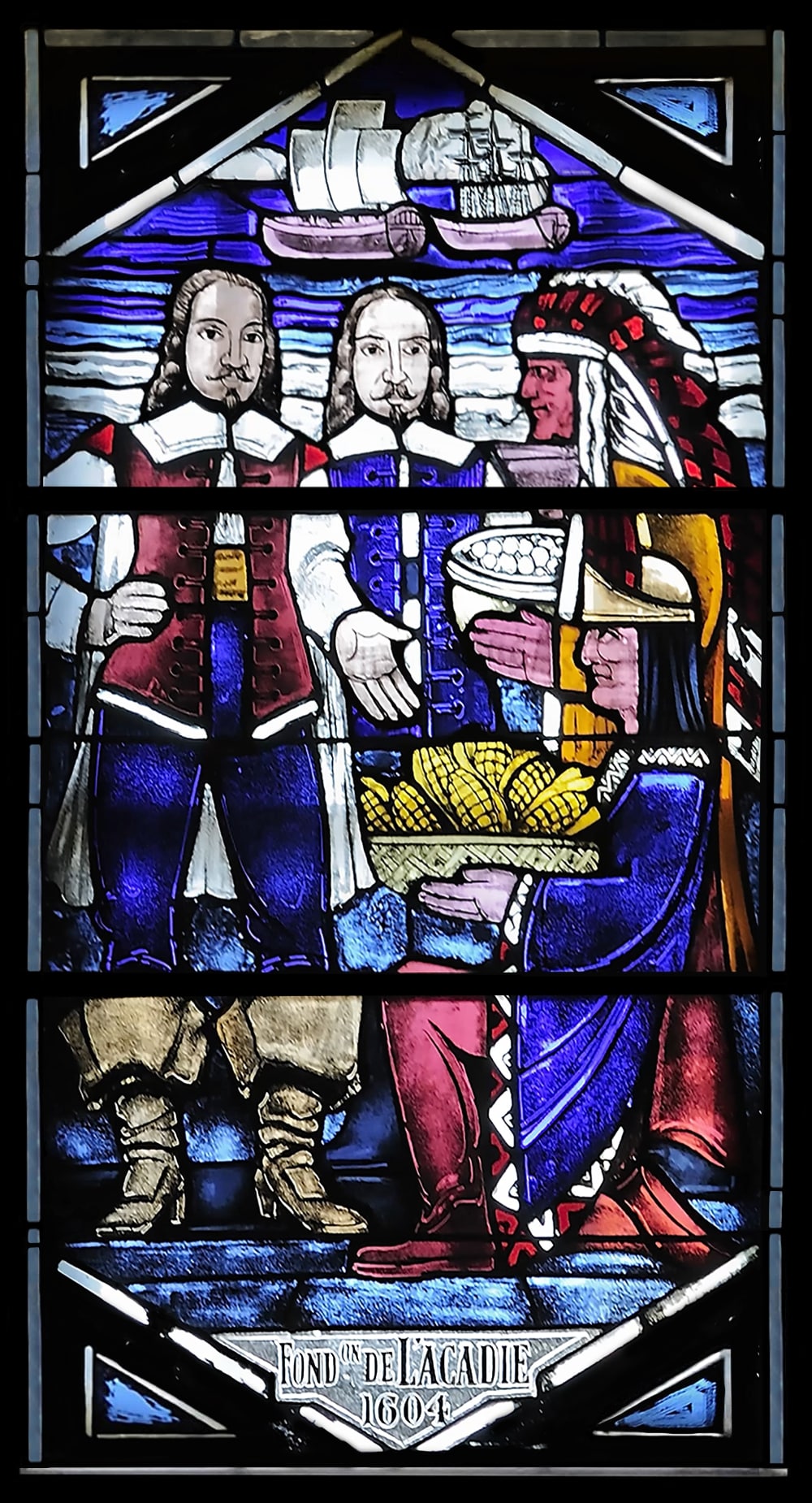
The first scene, titled “The Founding of Acadia,” accurately portrays the origins of Acadia, beginning at the arrival of French settlers in Port Royal, Nova Scotia.
In the 1500s, the French explored the region that is now known as Canada, and met the people who lived there, the First Nations. These individuals had a strong influence on the establishment and the survival of the French settlers. In 1604, after having explored the Bay of Fundy, an initial group of settlers led by Samuel de Champlain, Dugua de Mons and Jean de Biencourt tried to inhabit Saint Croix Island, near what is now New Brunswick. Their attempt was an utter failure: the weather was not suitable for settling a colony, and the winter of 1604 led to the death of at least 36 of the 80 colonizers, most of whom succumbing to scurvy. In 1605, a new, more promising location was chosen, and Port Royal became the first permanent French colony, marking the birth of Acadia.
During the years that followed, mostly from 1607 to 1610, the newly founded Acadian people solidified their commercial monopoly, notably thanks to the help of the Mi’kmaq and the Wolastoqiyik, the two indigenous communities of the region. The Mi’kmaq survived through mostly hunting and gathering, like by taking the eggs from waterfowl, while the Wolastoqiyik preferred to cultivate corn. Both nations shared their knowledge of the land and their food with the settlers, helping them survive the harsh winters.
Labouret’s piece tries to capture, in a singular pane, the complex history that is the creation of Acadia. The west-facing glasswork’s first scene, therefore, prioritizes the relationship between the French and the indigenous peoples, rather than the technical aspects of colony settlement. However, these aspects are still depicted: at the top of the glass, you can see two boats, which were the preferred mode of transportation at the time and a symbol of the Acadian’s exploration efforts.
Four characters are present in this first scene: on the left is Samuel de Champlain, to the right is Louis Hébert, then an apothecary, and finally, the Mi’kmaq chief Membertou. These four men symbolize very well the relationship between the Acadians and the indigenous peoples that were established between 1607 and 1610. During this time they would have exchanged their knowledge of medicinal plants; Membertou would have watched over the new homes of the settlers, and likewise Hébert would have helped take care of Membertou before his death in 1610. Next to Membertou is an unidentified indigenous person whom we can assume to be Wolastoqiyik thanks to the plate of corn he offers to the French settlers, which is a specialty of that community.
This scene, the first of twenty that collectively form Labouret’s artwork, depicts the characters that lay the foundation of what will become the vibrant history of the Acadian people.