The Fulfilment

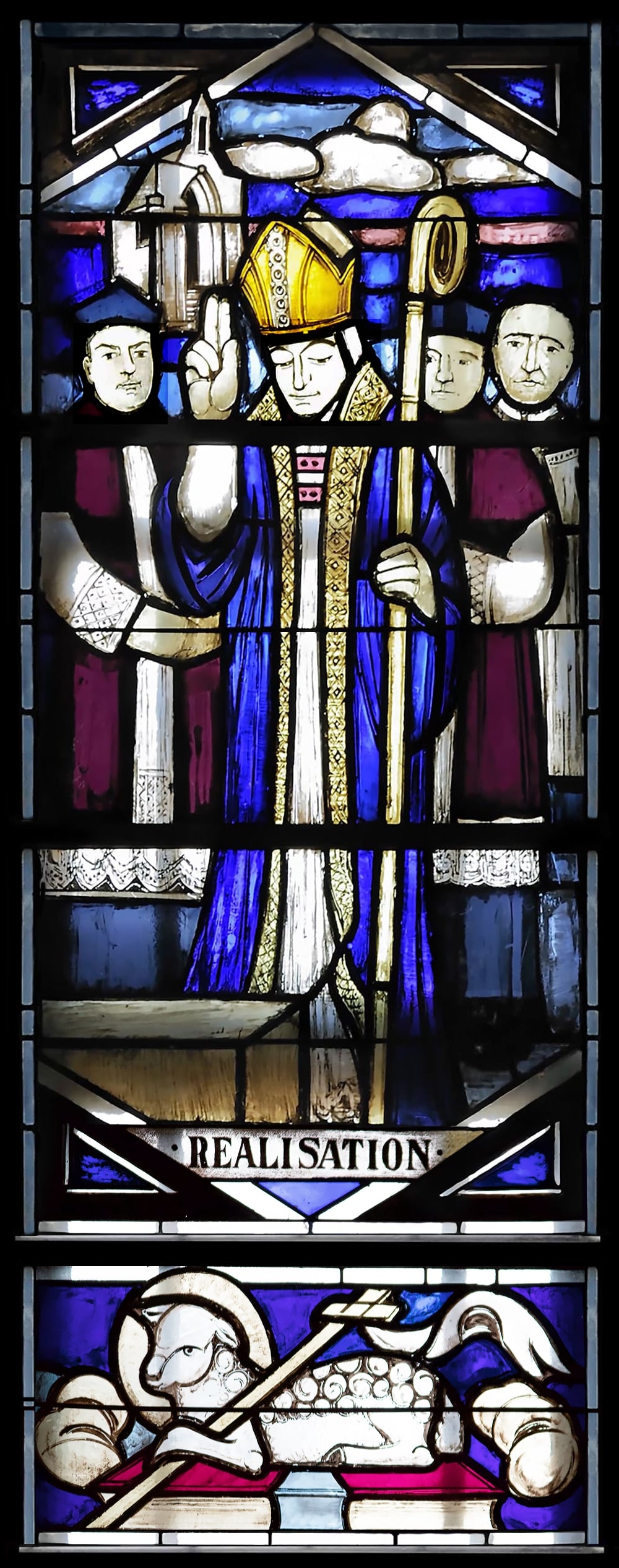
A stained-glass window commemoration the nomination of Mgr LeBlanc, the first Acadian bishop. It’s a scene wherein Bishop LeBlanc blesses three people in front of a church. – This window, titled “Réalisation” (The Fulfilment), commemorates the nomination of Mgr Édouard Alfred LeBlanc as the first Acadian archbishop of the diocese of Saint John in 1912, following the promise of Pope Pious X. The central scene depicts an archbishop, recognizable thanks to his mitre and his crozier, either blessing or speaking to three other people. In the background there seems to be a religious building. The lower segment of the window has an ewe and religious objects.

The ninth scene of this glasswork, titled “The Fulfilment,” continues the events of the previous scene. After the promise made by Pope Pious X to the Acadians to name an Acadian archbishop came the fulfilment of that promise. In 1912, two years after the promise of 1910, the diocese of Saint John welcomed the first Acadian Archbishop, Mgr Édouard-Alfred LeBlanc.

Mgr LeBlanc is shown in Labouret’s work wearing a ceremonial cassock and a mitre as well as holding a crozier: summarily, wearing and holding the metaphorical insignia of his new title. Interestingly enough, his naming as archbishop did not, at the time, soothe the worries of the Acadians, who, strongly nationalist, wanted their new archbishop to fight for their cause. Mgr LeBlanc, who hadn’t been very implicated in the nationalist movement, was deemed a safe choice who wouldn’t clash too much with the Irish clergy. Further, it was hoped he would himself appease the Acadians, who were viewed as uncooperative. Both sides of the debate greatly pressured him, but it was the Irish clergy’s hopes that were quickly dashed. Less than a year after being welcomed to the episcopate, Mgr LeBlanc sided with the Acadians and immediately started endorsing their demands.

In 1912, the same year as his ordination, he supported and directed the efforts of the Acadian Catholic community, who was trying to withdraw from the Saint-Bernard parish. At the time, the service was only led by Anglo-Irish ecclesiastics, which no longer suited the Acadians. Their demands, after their withdrawal, were that a francophone parish be created, and an Acadian priest be named to lead it. Labouret’s glasswork depicts their success. In 1914, the new Our-Lady-of-the-Assumption parish was established by Archbishop Melanson, for Acadia, as recognition for Mary. The name might be familiar, and with good reason: it’s the same parish where would be later be built the Our-Lady-of-the-Assumption Cathedral.

On the glasswork, Mgr LeBlanc can be seen blessing the corner stone of the parish’s new church crypt. At his feet is said corner stone, and behind him is a character representing the success of the Acadians’ second demand: Henri Cormier, the first priest of the new parish. An Acadian priest for an Acadian church. He held this title for 25 years, before passing away in 1938, the same year that the Cathedral’s building plans were solidified, plans to which Mgr Cormier contributed heavily until his death.

Title: The first Acadian bishop, Mgr Édouard-Alfred LeBlanc, will advocate for the nomination of the second Acadian to join the episcopate, Mgr Patrice-Alexandre Chiasson.
Source: ©Centre d'études acadiennes Anselme-Chiasson

Title: Mgr Cormier, the first priest of the Our-Lady-of-the-Assumption parish
Source: ©Centre d'études acadiennes Anselme-Chiasson PB1-195a

Bg a propos bottom edge