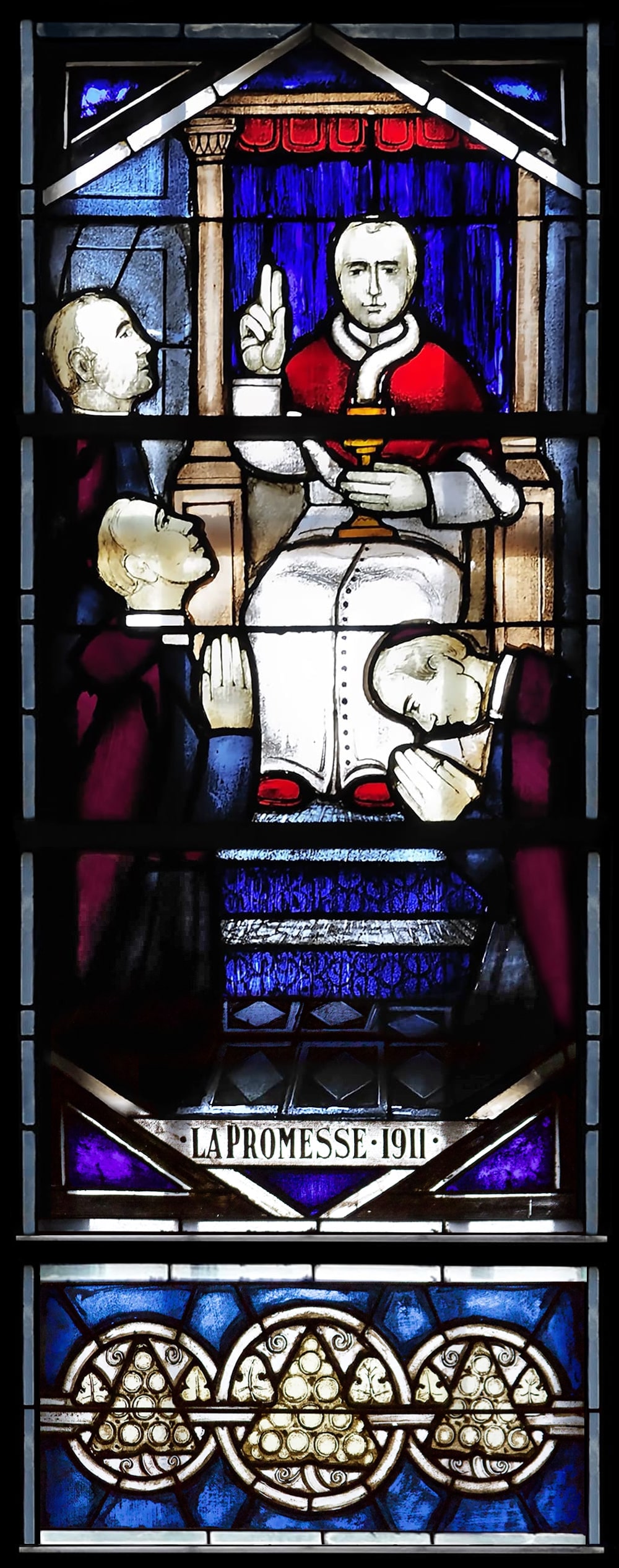
“The Promise” is the eighth scene in the transept’s western stained glass windows, and with it Labouret slowly but surely gets closer to modern Acadian history—modern at the time of the window’s creation in the early 1940s. The promise the pane is referring to is that of Pope Pious X, who, in 1910, promised to name an Acadian archbishop. There is a small error in the artwork; the date written is 1911, despite the correct year being 1910.
In order to understand the significance of the Pope’s promise, it is important to understand the religious context in Acadia at the time. Acadians were pious Catholics, and they often turned to this aspect of their daily lives to define their identity, especially after the deportation, when Acadia as it was had disappeared and Acadians struggled to find their place in society. Above all a family matter, religion was, to Acadians, an identity marker. It is present in numerous aspects of the Acadian Renaissance, above all in the heavy symbolism dedicated to Mary, protector of Acadia. Acadia’s national anthem, the Ave Maris Stella, celebrates Mary; the national Acadian holiday, on August 15th, was chosen because it was the day of the Assumption of Mary; The Acadian flag wears the Star of Mary. Religion, often by way of Marian representation, was incredibly important to Acadian people.
However, at the beginning of the 20th century, navigating religion and social belonging wasn’t always easy, especially for Acadians. Tensions rose between Acadians and Irish immigrants, who both occupied the same Catholic space. At the time, the space was dominated by the Anglo-Irish, not in number—Acadians were quite more numerous—but in power. In short, Anglo-Irishmen dominated the ecclesiastical hierarchy in the Maritimes, and the interests of francophone Acadians were not always prioritized. The need was felt to name an Acadian archbishop who would be a spokesperson for the people and who would prioritize the inauguration of francophone schools and the spread of Acadian jobs.
Mgr Marcel-François Richard is one of the people who held the cause close to their heart. He worked very hard for its fulfilment; he went to Rome on three occasions to present the request to the Pope in person. Finally, in 1910, Pope Pious X answered the Acadians’ wish and promised them an archbishop from their own culture. As a token of his promise, he offered Acadians a golden chalice that Mgr Richard received in their name. That is the scene Labouret depicts in his work; Pope Pious X, sat upon the papal chair, chalice in hand, surrounded by Mgr Richard and the Reverends Stanislas Doucet and Jean Hébert. The pope’s promise to name an Acadian archbishop was evidence of his trust in the faith of the Acadian people, who have held, since then, the ability to self-govern themselves in religious matters. Where a relatively short time beforehand, the Acadian people struggled to carve a space for themselves in the parishes shared with the Irish, the groundwork set by this promise led to the naming of their own archbishop and the jewel of their heritage: the Cathedral Our-Lady-of-the-Assumption (Notre-Dame-de-l’Assomption), dedicated to Mary, who guides Acadia through its dark times.
Title: Official portrait of Pope Pious X, after being elected pope in 1903