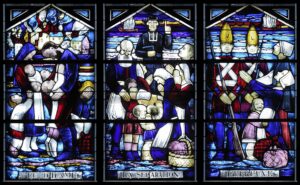
The Awakening

“The Awakening” is the third triptych in this glasswork, and it depicts an important moment in the history of the Acadian people: that of their renaissance. Almost a century had passed since the deportation and subsequent dispersion of the Acadians, and Acadia was in the throes of what could be qualified as an identity crisis. The tragedies of the past fell through the gaps of time and took with them the Acadian pride, which struggled to reestablish itself. The Acadian Renaissance echoed the Renaissance movement that started in Italy in the 14th century, and brought honour back to the Acadian identity, culture and heritage, by means of literature, legislation, and economic development. This chapter of Acadian history culminates in the event represented in the triptych: the first Acadian national convention in 1881.

The convention put an end to over a century of isolation; the Acadians, after returning to Acadia following the deportation, lived discreetly and were often considered to be—both my themselves and by others—second-class citizens, lesser to the anglophones. The translation of the poem Évangéline in 1865 marked the first real upswing in the Acadian Renaissance movement. The Acadian people regained their pride and, for the first time, started reclaiming their self-confidence and the place they deserved in society. The convention of 1881, which happened in Memramcook, is about the interests of Acadia and nothing else. The subject matter of all the following conventions is the same. The 16th, and final, convention happened in 1979. For this last meeting, many people gave speeches and hosted passionate debates, at the end of which some important decisions concerning Acadia’s future were made.

Taking a closer look at Labouret’s depiction of the event, notable details and characters associated with the fist Acadian national convention are present. On the left pane are seven characters, and while they are unidentified, their positions are noteworthy. They are together, hands joined in prayer, and among them, a hint to the strong presence of the Catholic faith in Acadian culture, is a nun. However, it’s what’s in the background that is of greater interest: it is presumably the Saint-Joseph college, the first francophone university in the Maritimes, and likewise the setting of the first convention. The opening of the institution 15 years earlier is thought to be an important factor in the growing awareness of the Acadian people, which led to their renaissance.

In the middle pane is the lawyer and member of the legislative assembly Pierre-Amand Landry. Not only was he the one to chair the convention, he was the first Acadian lawyer. In this scene, he is depicted a finger raised to the sky in order to attract the attention of the crowd surrounding him. He announces the result of the assembly’s decisive vote deciding the Acadian national holiday. The chosen date, August 15, is still celebrated as such to this day and symbolizes yet again the devotion the Acadian people have to the Virgin Mary, their protector. August 15 is also the day of the Assumption of Mary, which has mattered to the Acadians since the era of Louis XIII. The last pane to the right is linked to the middle one through context.

It depicts Mgr Marcel-François Richard, also known as the “architect” of the Acadian Renaissance, surrounded by a crowd. His contribution to this first convention is noteworthy, partially due to his influence in convincing the Acadians to affirm themselves as a whole. His passionate call to the awakening of the Acadian identity is framed as a suggestion: the guidance towards a national holiday dedicated solely to Acadians, distinct from the one dedicated to French Canadians.

In summary, “The Awakening” is a scene that illustrates the revitalization of Acadia, concretely implemented during the first Acadian national convention. If the Acadians stayed in the shadows during the century following the deportation, then the Renaissance is truly their awakening.

Title: Pierre-Amand Landry studied at the collège Saint-Joseph from its inauguration and became the first Acadian judge in 1890
Source: ©Bibliothèques et Archives Canada PA-028336

Title: Mgr Marcel-François Richard, priest and teacher, is one of the speakers at the first convention of 1881
Source: ©Centre d'études acadiennes Anselme-Chiasson Collection de photographiques PB1-212A

Bg a propos bottom edge