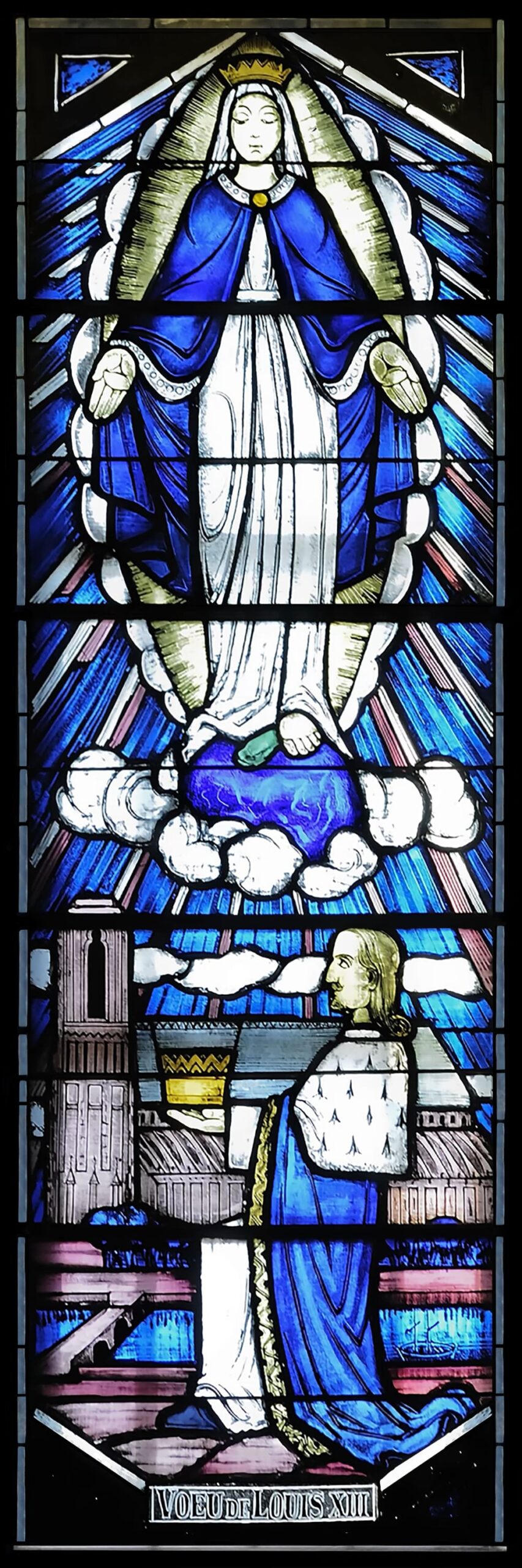
The biggest pane of the west-facing glasswork is the second scene, named “The Vow of Louis XIII.” This pane depicts Mary, and at her feet, the king of France in question; it symbolizes the first step in the Acadian people’s long history of Marian devotion.
Historically speaking, “The Vow of Louis XIII” refers to the time between 1632 and 1638 during which the king of France, Louis XIII, showed his and the French people’s devotion to the Virgin Mary through promises and prayer. It is claimed that the people’s and the king’s devotion had been recognized by Mary, who, in return, allowed them to be cured of a grave illness that was affecting the country. They also claimed that Mary had answered their pleas for protection by leading France to numerous military victories. At the time, the threat of Spanish invasion was constantly on the horizon, but France resisted foreign incursion and maintained its global power. Finally, the birth of Louis XIV, the first heir to Louis XIII with Anne of Austria, born after 23 years of marriage, had reportedly been an answered last prayer to the Virgin Mary by Louis XIII.
The pinnacle of this string of events was the consecration of France and its colonies to Mary on February 10, 1638, as a thanks for the miracles she had accomplished in the name of the king. In Christianity, consecration, or likewise to consecrate yourself, means to pledge or to devote someone or something entirely to the service of divinity. This action meant that France was now forever dedicated to Mary and that she was the country’s protector and patron. At the time, Acadia was still a part of the French colonies, which is one of the ways that Mary and Acadia are historically connected in the culture’s foundation.
Further proof of the French devotion to Mary, the king Louis XIII instituted the processions of August 15, the date celebrating the Assumption of Mary. During these processions, people must pray and thank Mary for allowing France and its colonies to succeed.
The true meaning of the title of “Monument of Recognition” is depicted in this glasswork by Labouret. The art on the pane shows Mary in her Assumption, watching over all, and Louis XIII kneeling before her, consecrating France to her and offering her his recognition by the symbol of a crown he holds in his hands. This pane shows why the Cathedral earned its title of temple of Acadian recognition to Mary, recognition whose origins date to almost as far back as Acadia itself. August 15th is still, after all, the national holiday of Acadia, a testimony of the eternal gratitude its people have towards their patron.
Title: The Vow of Louis XIII (Le Vœu de Louis XIII), oil on canvas by Jean Auguste Dominique Ingres, 1824