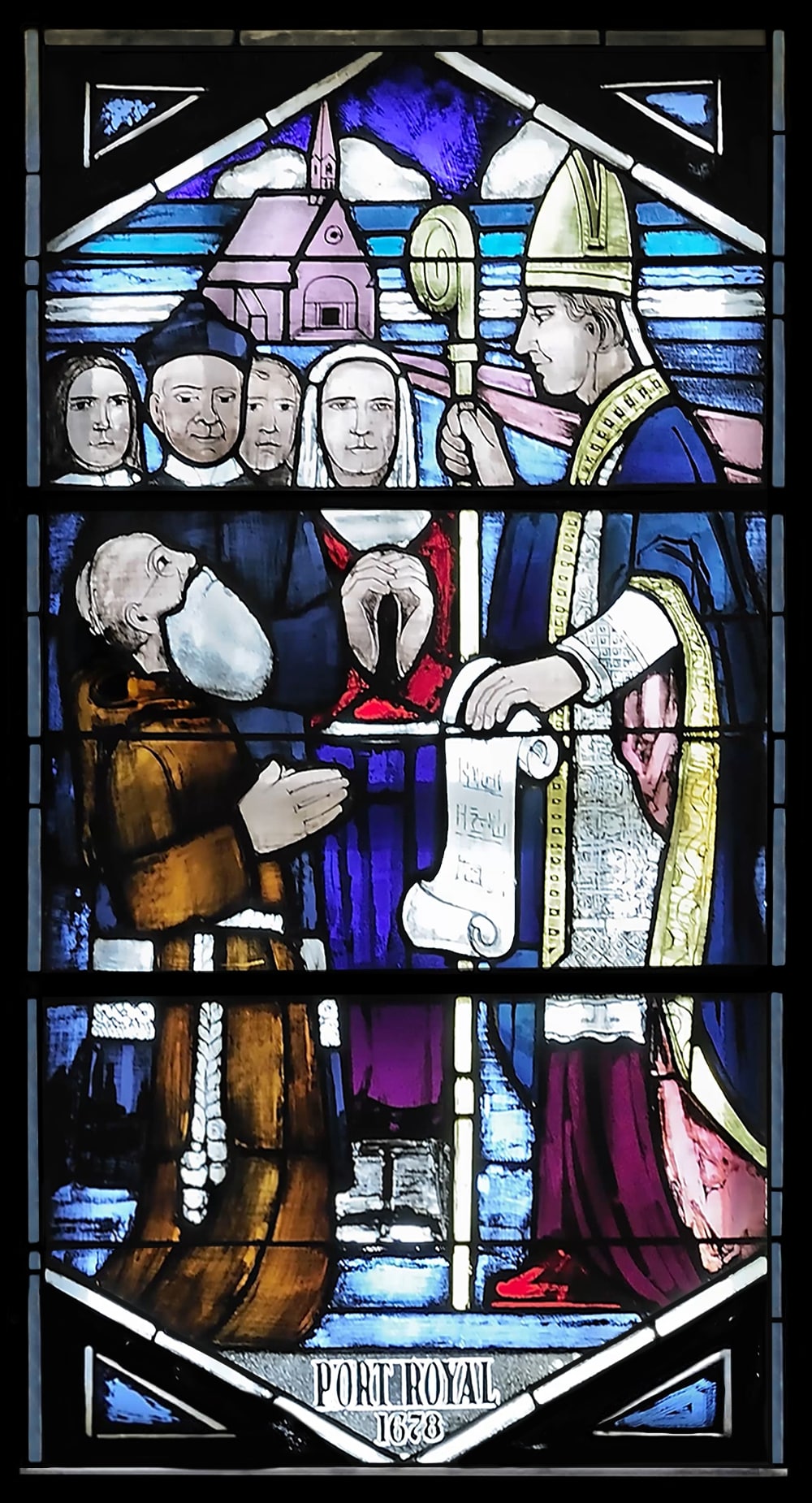
The third scene of the glasswork, titled “Port Royal,” depicts another step in the foundation of Acadia: the root of Catholicism in Acadian culture. Historically, Catholicism is an important aspect of Acadian identity, and from the various colonies’ beginnings, they followed in the steps of France, a country consecrated to the Virgin Mary.
At the time, in the early 1600s, as the colonizers had just settled in New France, the Church and the State had formed a united front, and ecclesiastics held a major influence. It’s not a situation unique to French territory nor to the times; the Church’s history of political power was even longer than that of France.
This scene in Labouret’s stained glass depicts a small part of history, that of the creation of the first religious institutions in Port Royal. There are six characters, only two of which are identified. In the forefront, to the very left, is Mgr François de Laval, and kneeling before him is a capuchin monk. The first concrete marks of religious influence in Acadia are connected to these monks, who executed a mission from 1632 onward, and helped create the first religious schools of the territory. The religious branch in question, the Capuchins, belongs to the first religious order of the Franciscan family, a school of thought preaching poverty and brotherhood. The monk in Labouret’s work wears the characteristic clothing of Capuchin monks; the brown tunic and a rope for a belt. Although the Capuchin mission ended in 1654, disrupted by English influence, their impact remains. They were still the main religious order in Acadian territory when, in 1678, Mgr François de Laval erected the first Acadian parish in Port Royal.
The other character identified in Labouret’s work, Mgr de Laval, is depicted holding a crozier and presenting a document to the Capuchin monk. Born in France, this Catholic saint was, at the time, the very first Archbishop of Quebec. It’s thanks to a long string of trips through his diocese, whose territory extends from the St. Lawrence River to Mississippi, that he made a stop in Acadia. His work in Port Royal ended with the opening of the first parish. Aware of the special relationship between French settlers and the Virgin Mary, he placed the new institution under her protection.
Yet again, Labouret’s artwork shows the link between Acadia and Our-Lady-of-the-Assumption. The “Monument of Recognition” justifies its title, and with the Virgin celebrated in another of the panes, Labouret showcases another historical link between the Acadian people and their protector.
Title: Map of the Port-Royal Fort (Plan du fort du Port Royal à la Cadie) by Jean de Labat, 1702