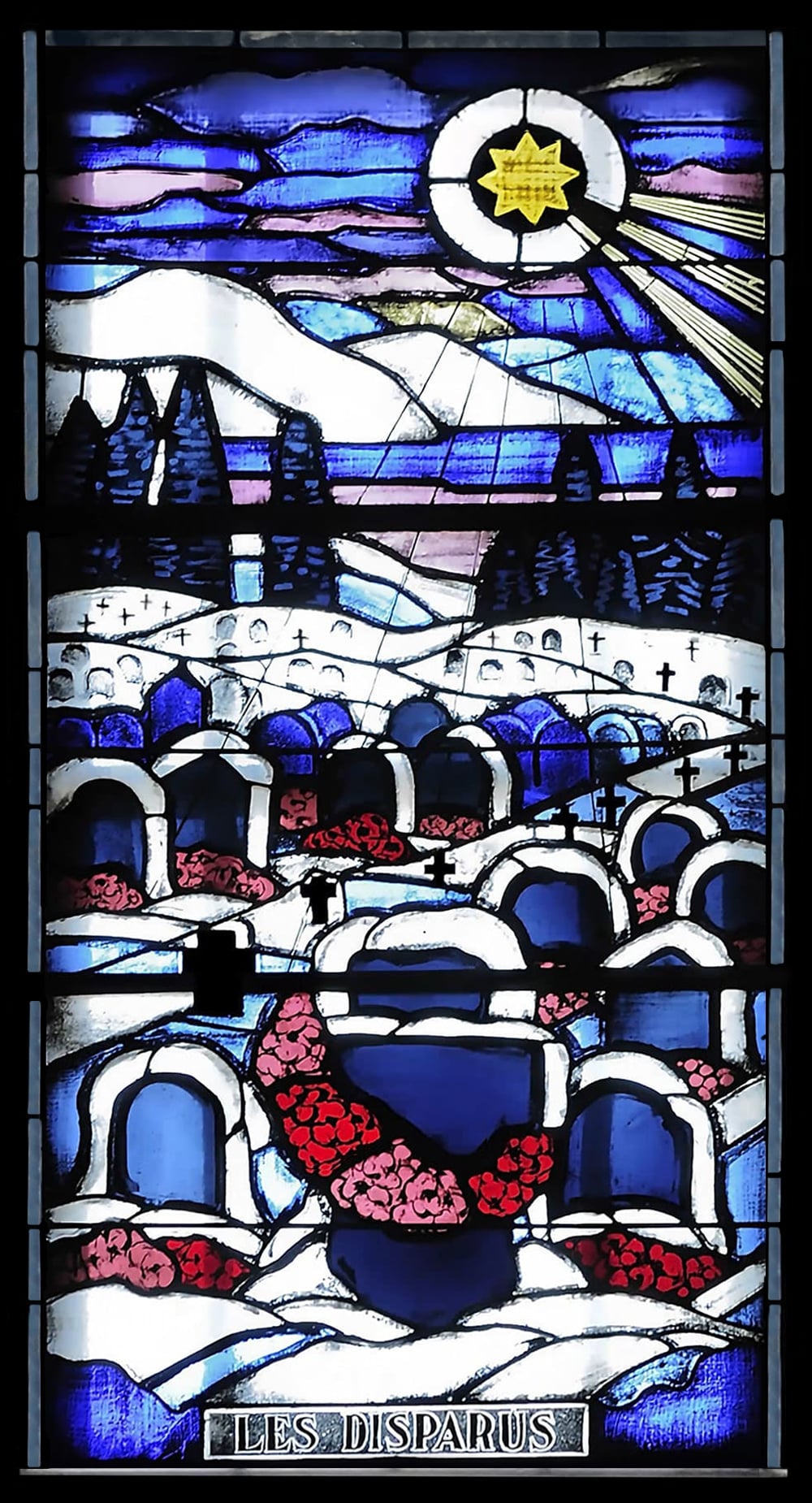
The first scene, “Les Disparus,” is simple, but poignant: it’s a cemetery. Many rows of tombstones are visible, and although the location is not identified, it doesn’t matter in the context of the artwork. Rather, it’s the symbolism that is striking, symbolism that, for the Acadian community, holds much implication. “Les Disparus” are the thousands of Acadians who drowned, starved or succumbed to disease while onboard the ships that deported them. They are the men, the women and the children who died cruelly, unknown and alone, away from their families and their homes, many of whom never received dignified burials. This scene is practically dripping with symbolism, with the unnamed tombstones representing those departed whom history tried to erase. Higher on the glass is the Star of Mary, a reminder of the Acadian people’s survival despite the tragedy. The star shines as a reminder of hope despite injustice: it’s the same star that shines on the Acadian flag, symbol of Mary, patron of Acadia. Once again, the strong links between the Virgin Mary and the Acadian people are depicted in the glass, justifying the accuracy of the Cathedral’s title, “Monument of Recognition.”
“1755,” the second scene of the triptych, could also be called “Évangéline” thanks to the significance it gives to her character. On the window is a large cross, waves, rays of sun overflowing from the first scene, and a woman sitting, holding her head in her hands. The entire window is filled with meaning. To start, the waves are a relatively simple aspect of the pane: they are a continuation of the narrative of the previous triptych and represent the sea that took the Acadians, either to disperse them throughout the world or to take their lives. Then, the cross can both represent the Christian faith as well as the Acadians who died or disappeared following the deportation. Specifically, in conjunction with the crouching woman in front, the cross symbolizes grief. Said woman is none other than Évangéline, the fictive heroin in the poem of the same name by the American Henry W. Longfellow. She occupies a massive role within Acadian heritage, as her fictional story, in which she loses her love, Gabriel, due to the deportation, is also that of Acadia.
Published in 1847, Évangéline, the first literary work about the deportation, reignited the memory of the event within the Acadians, which had been somewhat forgotten at the time. It is no doubt the most significant and monumental work in Acadian history: it created a feeling of pride and renewal in Acadian people, leading to what historians call the “Acadian Renaissance.” In Labouret’s glasswork, Évangéline is more than an Acadian woman; she is Acadia, or at least its personification, as she grieves, crying for the people who were taken from Grand-Pré. The rays of sunshine illuminating her are representative of Mary, and in this one scene the two most important women for Acadia are united. They are more than Mary and Évangéline, they are Acadia’s protectors, watching over its people after its greatest tragedy, and Acadia draws inspiration from them in order to get back up and rebuild itself.
The triptych’s last scene, “Le naufrage,” portrays a ship sinking in the sea’s tumultuous waters. Shipwrecks are the cause of some Acadian deaths; the ships on which Acadians were taken were sometimes trapped in merciless storms. The sea, death, and death by the sea are all themes often present in artistic representations of the Acadian drama, of which this triptych is the pinnacle. Evocative in its simplicity, it encapsulates the tragedy of the Acadian deportation. “La dispersion,” no doubt the most abstract scene in the whole of Labouret’s work for the Cathedral, is a powerful reminder of the improbable survival of the Acadians and the depth of their heritage.