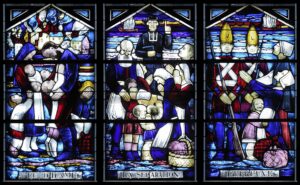
The third triptych is noteworthy in part thanks to its incorrect title. The Miscouche convention happened in 1884, regardless of what the title “Miscouche 1886” would imply. Since the year 1886 cannot be linked back to the second Acadian national convention in any meaningful way, one must assume it to be a simple mistake. It was on August 14 and 15, 1884, in the church and convent of Miscouche that thousands of Acadians travelled to meet up. After the success of the 1881 convention, which ended with a new national holiday, the Acadian people’s enthusiasm only grew, to the point where separate lodgings had to be arranged when Acadians from the Maritimes, Quebec and even Maine joined those from PEI to discuss the future of Acadia. Labouret’s work depicts the Acadians joining their hands in prayer and celebrating the convention’s success.
Acadia’s future rests upon Acadian identity, which itself is greatly influenced by its protector, Mary. The first pane, “Hymne national,” (National Anthem) shows four Acadian characters, either praying or crying, kissing the new Acadian flag and singing the new national anthem. The anthem is the Ave Maris Stella, Latin for “Hail, O Star of the Sea.” This scene did actually occur during the Miscouche convention. Before the newly chosen flag, the crowd sang the new anthem, showing the great emotions that came with the decision. With the choosing of the anthem, the 1884 assembly immortalized the link between Mary and Acadia; the song is itself a celebration of the Virgin Mary. It is the same in the second pane, “Choix de drapeau,” (Choosing a Flag) which portrays the choosing of the Acadian flag.
The new flag is blue, white and red, the colours of the flag of France, the country from which the Acadians came. On it is also a star: the Star of Mary, who earns herself yet another place of honour in a symbol dear to Acadia. The vote is unanimous, and Mgr Marcel-François Richard, an influential figure in Acadia’s development, is the one to ceremoniously deploy it for the first time before an impassioned Acadian crowd.
The scene, as Labouret shows it, is grandiose and interconnects the characters from all three panes, such as Mgr Richard, all gathered around the flag he holds, gazing upwards at the Star of Mary illuminating the scene. The rays of the star—star which is situated in the centre pane— spread over the entire depiction and surround the Acadians, who are declaring their gratitude to Mary, gratitude they will keep uttering for centuries to come. The title of “Monument of Recognition” given to the Cathedral only gains meaning when the symbols dedicating Acadia to the Virgin Mary are illustrated so beautifully.