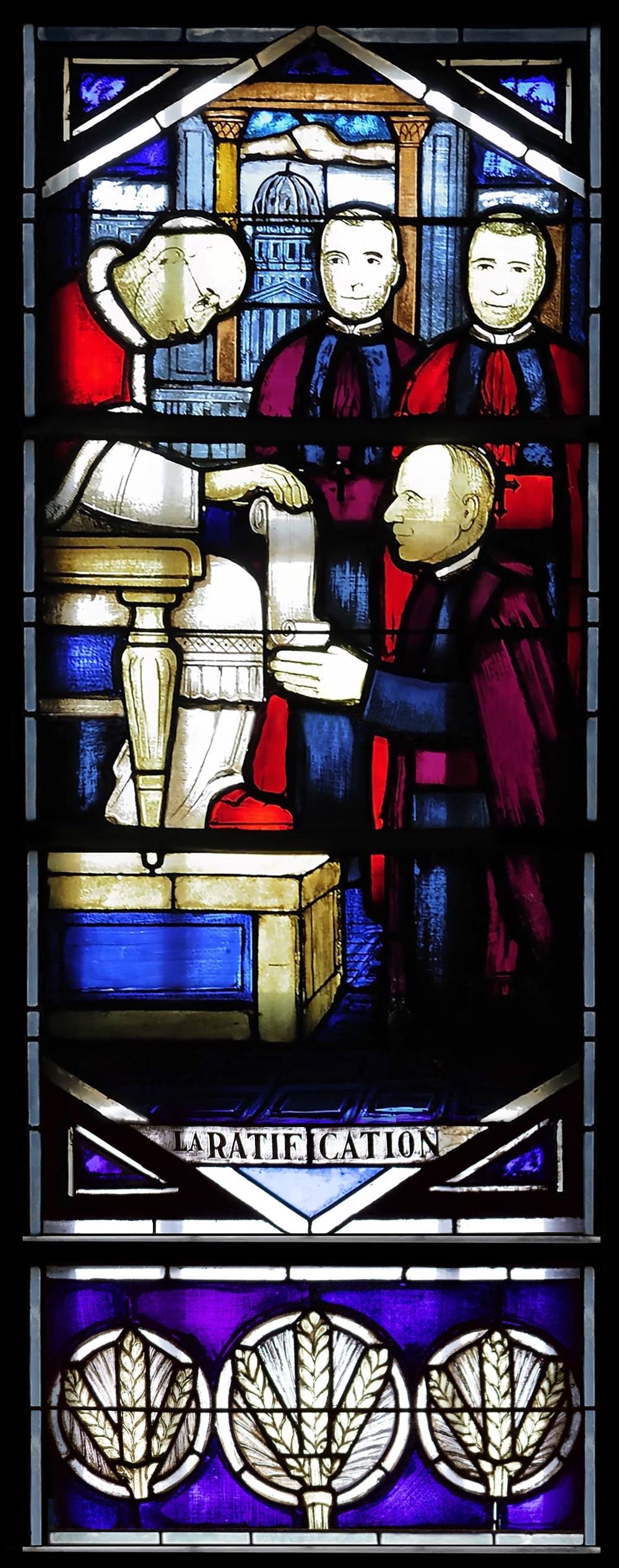
The last window of the transept’s west-facing glasswork is titled “The Ratification,” and it’s the last chapter of Acadian history before the construction of the Cathedral Our-Lady-of-the-Assumption. The window’s scene occurred in 1938, and it represents the summit of the long history uniting the Acadian people and its protector. In 1938, Pope Pious XI declared August 15, previously both the day of the Assumption and Acadia’s national holiday, as their patronal day.
A patronal day is a festivity celebrating the given patron of a community or a parish, and in the case of Acadia, it is the formal endorsement of something that’s been true from the very beginning: Mary is the patron saint of Acadia. The people pray to her, thank her, and are devoted to her. The national anthem, the national holiday and the flag of Acadia are all, in one way or another, dedicated to Mary. Therefore, “The Ratification” is the ultimate recognition, by the leader of the Catholic church, of the Acadian people’s devotion to Mary. Labouret’s glasswork depicts the Pope, sat to the left, holding the long awaited apostolic decree; the one declaring the patron day of Acadia to be the same as the day of the Assumption. At his feet, receiving the decree, is one of the most important characters in Acadian history.
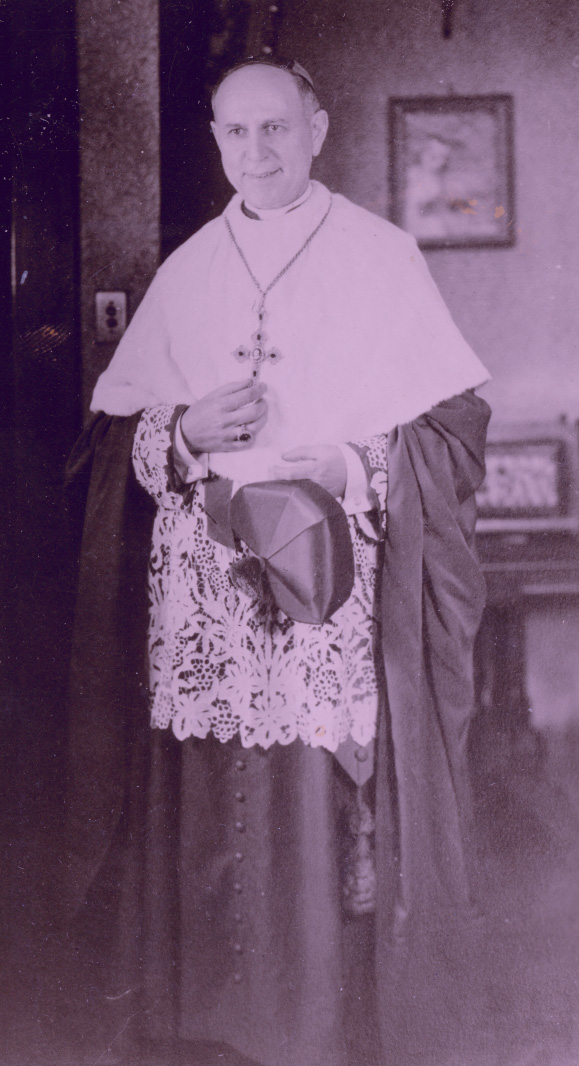
Mgr L.-J.-Arthur Melanson, first archbishop of Moncton, first Acadian archbishop, and integral figure in Acadia, appears in Labouret’s work. It’s after decades of effort by characters such as Mgr Édouard-Alfred LeBlanc that the Moncton archdiocese was created in 1936, from where everything rapidly grew. Mgr Melanson took up his post on February 22, 1937, and ensured, during his episcopate, the construction of an element of Acadian heritage that still shines to this day: Our-Lady-of-the-Assumption Cathedral, the Monument of Acadian Recognition.
The contribution Mgr Melanson gave to this monumental work extends to even the glasswork on which he is depicted: Labouret’s work had to be approved by him, after which it could be installed in the Cathedral. He passed away in 1941, but even today the legacy he leaves to Acadia can be felt.
On Mgr Melanson’s sides in the scene are Patrice-Alexandre Chiasson, bishop of Bathurst, and Andrea Cassulo, apostolic delegate in Canada, both of whom played a major role in obtaining “The Ratification.” The Acadian, Chiasson, and the Italian, Cassulo, worked together with Mgr Melanson to recognize one of the most important symbols in the Acadian community.
Finally, although the history of Acadia shown in Labouret’s art ends in 1938, it remains—both within and out of the walls of the Cathedral, an incredibly vibrant and important historical piece. The aspects of Acadian heritage that are dedicated to Mary remain, and although times change and their meanings fade, they are deeply engraved in Acadian history.
Title: The first Acadian archbishop, Mgr Louis-Jospeh-Arthur Melanson