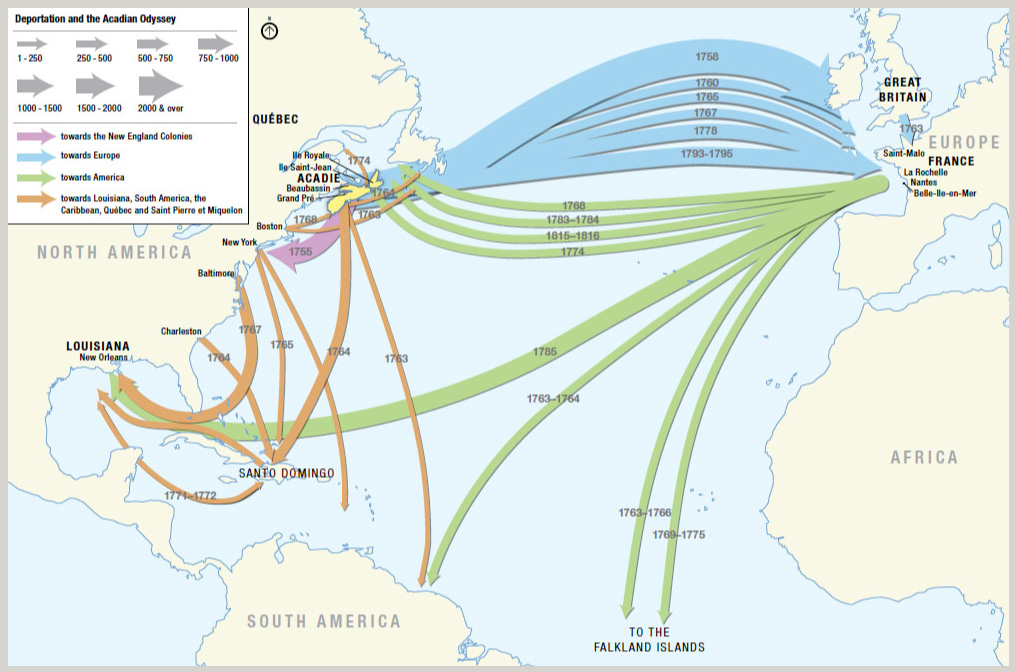
At that point, the British feared Acadian retaliation due to their French origins. Additionally, they coveted the Acadians’ fertile lands. Acadians, who were a self-contained community with a shared identity, had been minimally implicated in New France’s conflict. However, in 1755, they refused to sign an oath of unconditional allegiance to New England, and, since the English were the lead colonial power in America after its victory, England had the resources to enact a plan to get rid of the Acadians, who could pose problems later down the line. Therefore, the Acadians were deported en masse. Plans for an Acadian deportation had been present as early as 1720, when New England authorities already doubted the Acadian people’s loyalty to the British crown.
On the eve of the Deportation, Acadian houses and fields were set aflame, and families were separated and placed onto boats. They were sent to South Carolina, Georgia, Pennsylvania, and England, where they received a hostile welcome and were mistreated. This event has marked Acadia more than any other in its history, and it holds much weight in Acadian heritage.
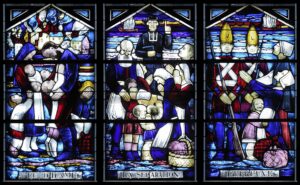
Labouret’s interpretation of this chapter of Acadian history is more complex; the three panes allow for more detail to be shown. That being said, each scene is still overflowing with information. The first, “Le Drame” (The Drama), contains many unidentified Acadian characters, some of whom are in tears. A man and a woman are present, each with a child grabbing at their arms. “Le Drame” represents the tragedy of the deportation by showcasing the separation of families, and in the background of the scene, blazing homes. The second pane, “La Séparation” (The Separation), depicts what is presumably a family—a man, women and children—either crying, praying, or hugging each other for the last time. Behind them is what seems to be an unidentified British man, likely carrying out the deportation, and behind him, the sea and the boats that would take the Acadians far away from their homes. “La Séparation,” (The Seperation) understandably, represents the members of Acadian families who were sent away by sea; ripped from one another and from their homes. The third scene, a continuation of the first two, is “L’Épreuve” (The Test). It illustrates two British soldiers, surrounded by Acadian women and children. The women are kneeling, either praying or begging, and around them lay bundles. Behind them, the sea and a boat represent how it’s time to leave. “L’Épreuve” is an foretelling of challenges to come, and concludes this chapter of the Great Upheaval.